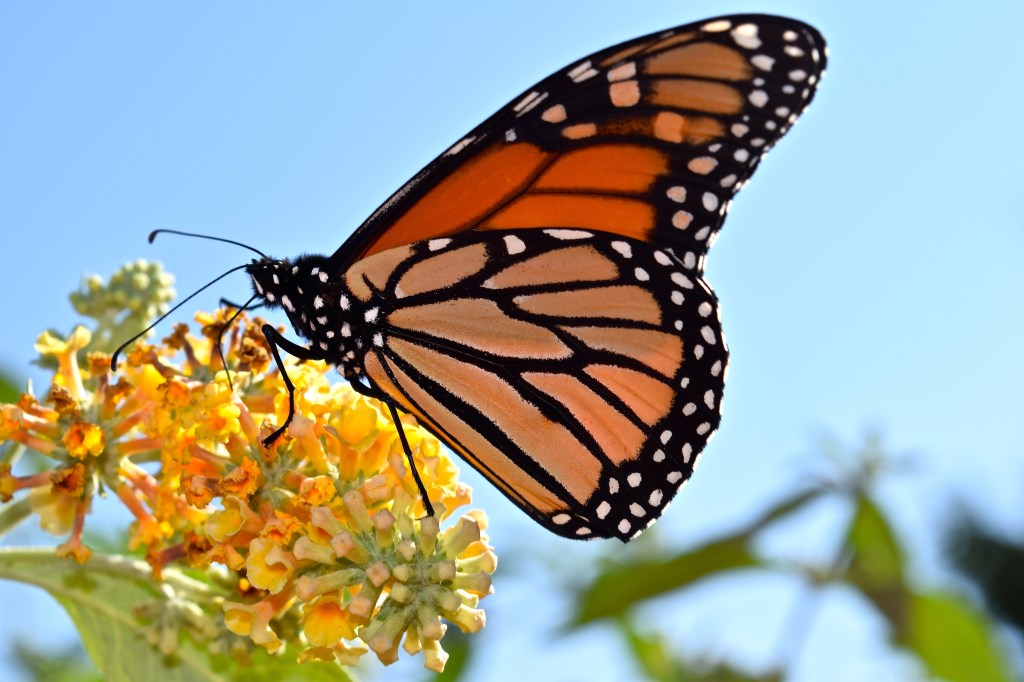
If you don’t live under a rock and you have social media, you’re likely to have seen the pearl clutching going on around monarch butterflies being infected with OE, or it’s lesser-known name Ophryocystis Elektroscirrha. OE is a protozoan parasite that infects their species of butterfly but is currently being used to lament the poor Monarch butterfly population. The three species that OE is found to be infecting is Monarch, Queen and Lesser Wanderer. Monarch and Queen butterflies are naturally found in North and South America, with Lesser Wanderer living in Australia and tropical climates.
I haven’t seen a social media post truly addressing the facts but rather relying on fear and pearl clutching. In regard to the Monarch butterfly, there is more scientific information that needs to be assessed and put in posts instead of the simple, “Save the Monarch” mantra. Ignoring the other two species, Monarch are made up of two separate but similar species, the Danaus Plexippus and Danaus Erippus. Have both species been affected by EO or just one? I couldn’t find any definitive answer to this which makes me wonder if they’ve yet to go down that rabbit hole. In addition to this, there are three groups of Monarch butterflies that have completely different infection rates.
There is one population living the California dream that’s coming in at a whopping 30% infection rate, one population over in Florida that’s infected at 70% and another population over in Mexico that comes in at a mere 8% infection rate. The Florida population seems to migrate the smallest length, followed by the California population in the middle and the Mexican seems to be the largest going all the way up to Canada. In fact, if you are watching some nature tv show, the footage and subject is likely to be the Mexican migration.
People are loosing their minds saying that the Tropical Milkweed is the species that is causing the OE spread, but the reality is that it’s literally contaminated both native and non-native. The big difference between the two is that the native will die back in winter and with it goes the leaves which carry the spores of OE. It’s not like we can destroy all milkweed because it’s the primary food source of many butterflies, not just Monarch. If you destroy all the milkweed, you destroy not 70% of the species but closer to 100%.
OE is destructive because it mutates the butterfly’s wings and form so that it’s unable to fly and live out its life normally. It’s sad, but we don’t need to insist the govt mandate something, create some ridiculous tax or even protest. Protesting doesn’t work, we don’t need any more taxation and everything the govt touches turns to crap.
My theory is that heat and moisture are working on the side of OE as Florida has incredibly long warm humid months with a short mild winter and California has a dry heat and short winter which may explain the huge difference in infection rate. If you stop and think about spores on the whole, they love warm weather and loads of moisture. The Monarch group that moves from Mexico to Canada is exposed to various temperature spikes as they migrate, which may serve to thin out the population and leave only the strongest of the group to survive and populate. Furthering the idea that they are potentially stronger, the population the migrates from Mexico to Canada appears to have multiple generations that are breeding with stronger species.
I live on 2.5 acres and I can tell you that I’ve not yet experienced seeing any misshapen Monarch butterflies and I have a variety of milkweeds around my property. I don’t spray pesticides, herbicides and actually work hard to introduce as many varieties of native and zone friendly pollinator plants. Perhaps the individuals in areas where mosquito sprayers, herbicides, fertilizers and pesticides are commonly applied are causing the butterflies immune systems to not be strong. Within the last 5-10 years, there has been a huge push to get everyone planting milkweed and now people are pearl clutching as they try to reverse course.
I think I’m going to plant what I want in my little ecosystem and encourage you to look at the facts and do what you want within your yard’s little ecosystem, the importance of just planting something that flowers is what we should be working on to help all the butterflies.
 Suburban & Rural Homesteading Today